
Can Spinal Decompression Fix a Bulging and/or Herniated Disc Without Surgery in Baton Rouge LA?
Can Spinal Decompression Fix a Bulging and/or Herniated Disc Without Surgery in Baton Rouge LA?

If you have a bulging or herniated disc, you may be dealing with lower back pain, sciatica, numbness, tingling, or pain that travels into your leg. Everyday activities can become difficult. Sitting, standing, bending, sleeping, or walking may no longer feel comfortable.
You may also be wondering: Can spinal decompression fix a bulging or herniated disc without surgery?
The honest answer is that spinal decompression with the Accu-SPINA system is an effective, proven non-surgical treatment for many patients with bulging and herniated discs who want real relief without surgery.
At Capitol Spine & Rehabilitation, our team helps patients understand their options for natural, non-surgical back pain relief in Baton Rouge LA. Here is what you need to know.
Accu-SPINA Spinal Decompression Is An Effective Non-Surgical Treatment For Disc Problems
Spinal decompression with the Accu-SPINA system and IDD Therapy is a gentle, targeted treatment that uses computer-guided cycles of distraction and relaxation to decompress an injured spinal segment.
The goal is to:
- Reduce pressure on bulging and herniated discs
- Relieve lower back pain and neck pain
- Reduce sciatica and radiating nerve pain
- Improve movement and daily function
- Help you return to work, exercise, and normal activities
- Offer a proven non-surgical option for disc-related pain
At Capitol Spine, our spinal decompression treatment in Baton Rouge is focused on helping the right patients get lasting relief through advanced non-surgical disc care.
Clinical reports cited by NAM Corporation and IDD Therapy show strong outcomes for disc-related pain. An early lumbar disc study reported that 86% of patients with herniated lumbar discs achieved good-to-excellent relief. More recent clinical outcome reports have shown success rates of 92% for cervical spine conditions and 93% for lumbar spine conditions when using IDD Therapy protocols on the Accu-SPINA system.
A 2026 Journal of Physical Medicine and Rehabilitation study by Bartrom et al., “Quantifying Clinical Outcomes of IDD Therapy in Patients with Cervical and Lumbar Disc Bulges and Herniations,” also reported meaningful improvement after 30 sessions, with average VAS pain scores improving from 5.8 to 1.5 and ODI disability scores improving from 18.5 to 6.5.
The Accu-SPINA system is also presented by IDD Therapy as an FDA-cleared Class II medical device designed to deliver Intervertebral Differential Dynamics (IDD) Therapy, and IDD Therapy reports that the device has been registered in the FDA’s Global Unique Device Identification Database (GUDID) since 2016.
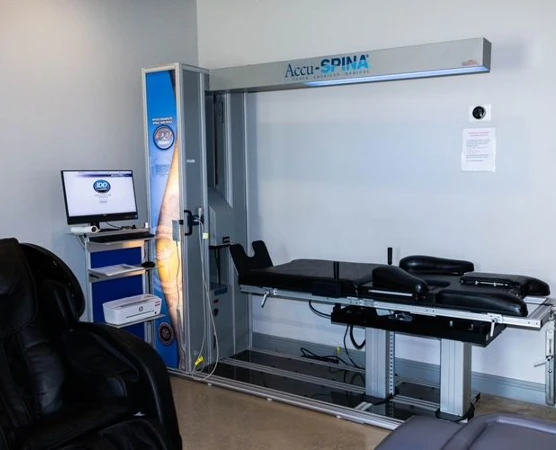
Authentic Capitol Spine Accu-SPINA treatment table and equipment in Baton Rouge.
Spinal decompression is different from surgical decompression. Surgery involves removing disc material, bone, or other tissue to relieve pressure. Non-surgical spinal decompression on the Accu-SPINA table is performed while you remain awake and does not involve an incision or anesthesia.
A Bulging Disc and a Herniated Disc Are Not Exactly the Same
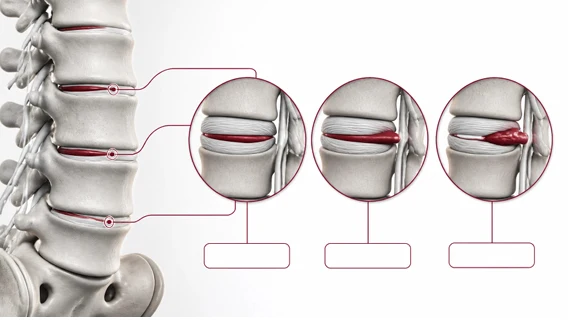
The terms “bulging disc” and “herniated disc” are often used together, but they describe different changes in a spinal disc.
Your spinal discs sit between the vertebrae and act as cushions. Each disc has a stronger outer ring and a softer center.
- A bulging disc extends beyond the normal boundary of the disc. The outer ring may remain intact.
- A herniated disc occurs when part of the softer inner material pushes through a weakened or damaged area of the outer ring.
Either condition may or may not cause symptoms. Some people have disc changes visible on imaging without significant pain. Others experience symptoms when a disc irritates or compresses a nearby nerve.
Possible symptoms include:
- Lower back pain
- Pain traveling into the buttock or leg
- Numbness or tingling
- Muscle weakness
- Pain that worsens with sitting, bending, coughing, or lifting
- Difficulty standing or walking for extended periods
A disc finding on an MRI is only one part of the picture. Your symptoms and examination matter, too.
So, Can Spinal Decompression “Fix” the Disc?
For many patients with bulging and herniated discs, Accu-SPINA spinal decompression is a proven way to reduce disc-related pain, improve function, and help avoid surgery.
Research and clinical outcome reporting on IDD Therapy support its effectiveness for disc problems, especially when treatment is directed to the involved spinal level and combined with a complete rehab plan.
Reported benefits include improvements in:
- Back and leg pain
- Neck and arm pain
- Function and disability
- Range of motion
- Disc-related symptoms associated with nerve irritation
- Ability to return to normal activities
NAM Corporation’s lumbar disc research summaries report that 86% of patients with herniated lumbar discs experienced good-to-excellent relief, while additional published outcome summaries report 92% success for cervical spine cases and 93% success for lumbar spine cases.
In the 2026 study by Bartrom et al., patients with cervical and lumbar disc bulges and herniations had major improvement after 30 sessions of Accu-SPINA IDD Therapy, including a drop in average pain scores from 5.8 to 1.5 and disability scores from 18.5 to 6.5.
This is why spinal decompression with the Accu-SPINA system is widely presented as a strong non-surgical treatment option for disc injuries and disc-related spine pain.
Many Herniated Discs Improve Without Surgery
One important fact is that some herniated discs improve over time with non-surgical care. The body may gradually reduce the size of some disc herniations through natural healing processes.
This does not mean you should ignore severe or persistent symptoms. It means surgery is not always the first or only option.
A conservative care plan may include:
- A detailed history and physical examination
- Digital X-rays or other imaging when appropriate
- Spinal decompression, if you are a suitable candidate
- Gentle chiropractic care when appropriate
- Physical rehabilitation and guided exercises
- Advice on posture, movement, lifting, and daily activities
- Progress checks to measure pain, function, and mobility
The right plan depends on the location and severity of the disc problem, your symptoms, your general health, and your goals.
Spinal Decompression Works Best With Active Rehabilitation
Passive care may help reduce discomfort, but long-term improvement often requires restoring strength, control, and confidence in movement.
That is why rehabilitation is an important part of care at Capitol Spine & Rehabilitation. Once movement becomes more comfortable, your plan may include exercises designed to support:
- Core strength
- Hip and pelvic control
- Spinal stability
- Flexibility
- Posture
- Balance
- Safe lifting and bending
- Gradual return to work, exercise, and normal activities
Our goal is not only to help you feel better during treatment. We also want to help you become the leader of your health and reduce the chance of recurring problems.
Who May Be a Candidate for Non-Surgical Spinal Decompression?
Spinal decompression may be worth discussing if you have:
- Persistent lower back or neck pain
- Sciatica or radiating pain
- A diagnosed bulging or herniated disc
- Disc-related pain that has not improved with basic care
- Difficulty with sitting, standing, walking, or sleeping
- A desire to explore non-surgical options
- A willingness to combine treatment with rehabilitation and healthy movement
Before beginning care, our team will discuss your symptoms, previous treatments, medical history, and goals. We may also recommend imaging or additional medical evaluation when needed.
Not every patient is a candidate for every treatment. Careful screening is important, especially if you have a history of fracture, severe osteoporosis, cancer, infection, recent spinal surgery, or spinal instability.
When Should You Seek Urgent Medical Care?
Most disc-related pain is not an emergency, but certain symptoms require prompt medical attention.
Seek urgent medical care if you experience:
- New or worsening loss of strength in the leg or foot
- Loss of bowel or bladder control
- Numbness in the groin or saddle area
- Severe symptoms affecting both legs
- Sudden inability to walk normally
- Back pain after a serious accident
- Fever, unexplained weight loss, or other signs of serious illness
These symptoms may indicate a condition that requires immediate medical evaluation. Non-surgical spinal decompression should not be used to delay emergency care.
What Should You Ask Before Starting Treatment?
Before you begin spinal decompression, ask:
- What may be causing my symptoms?
- Do my examination findings support this treatment?
- Is imaging needed?
- What results should we measure?
- How many visits may be recommended?
- What exercises or rehabilitation will I do?
- What are my other non-surgical options?
- When should I be referred for additional medical care?
A trustworthy provider should answer your questions clearly. You should never feel pressured to purchase a long treatment plan before you understand your condition and options.
The Truth About Spinal Decompression for Disc Problems
Spinal decompression with the Accu-SPINA system and IDD Therapy is an effective, research-supported non-surgical treatment for many people with bulging and herniated discs.
It is designed to help patients:
- Reduce pain
- Improve mobility
- Decrease pressure on injured discs and sensitive nerves
- Participate more comfortably in rehabilitation
- Return to work, exercise, and everyday activities
- Avoid surgery when non-surgical disc treatment is appropriate
A personalized evaluation is still the best way to determine whether Accu-SPINA spinal decompression is the right fit for your condition, symptoms, and goals.
If you are dealing with a bulging disc, herniated disc, sciatica, or ongoing back pain in Baton Rouge, contact Capitol Spine & Rehabilitation to schedule a consultation.
Call us at 225-926-1900 or book an appointment online.
If you want a proven non-surgical disc treatment in Baton Rouge, now is the time to take the next step. Book your consultation and find out whether Accu-SPINA spinal decompression is right for you.
We are here to listen, answer your questions, and help you explore a safe, gentle path toward relief and the lifestyle you deserve.
Sources and Further Reading
- Capitol Spine & Rehabilitation: Spinal Decompression in Baton Rouge
- NAM Corporation: Herniated Disc Studies for IDD Therapy, Spinal Decompression
- NAM Corporation: Lumbar Studies for Accu-SPINA, IDD Therapy, other treatments
- IDD Therapy: Published Clinical Studies confirm IDD Therapy success
- Bartrom et al. (2026), Quantifying Clinical Outcomes of IDD Therapy in Patients with Cervical and Lumbar Disc Bulges and Herniations
- IDD Therapy: How Clinics Using Accu-SPINA® Systems Stay FDA-Compliant
- IDD Therapy: IDD Therapy Treatment is Advanced Spinal Decompression

Monday
8:00am - 1:00pm
2:00pm - 6:00pm
Tuesday
8:00am - 12:00pm
2:00pm - 6:00pm
Wednesday
8:00am - 1:00pm
2:00pm - 6:00pm
Thursday
8:00am - 12:00pm
2:00pm - 6:00pm
Friday
8:00am - 12:00pm
1:00pm - 5:00pm
Saturday
9:30am - 12:30pm
Sunday
Closed

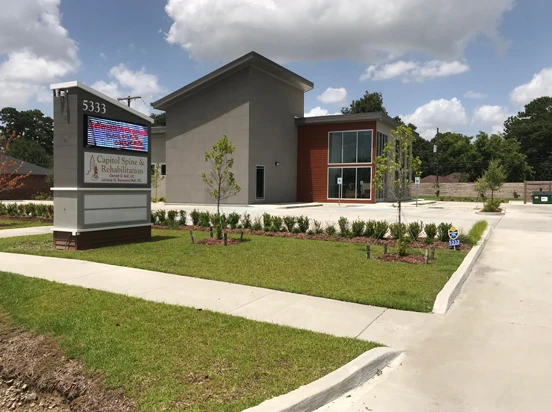
Capitol Spine & Rehabilitation
5333 Florida Blvd
Baton Rouge, LA 70806